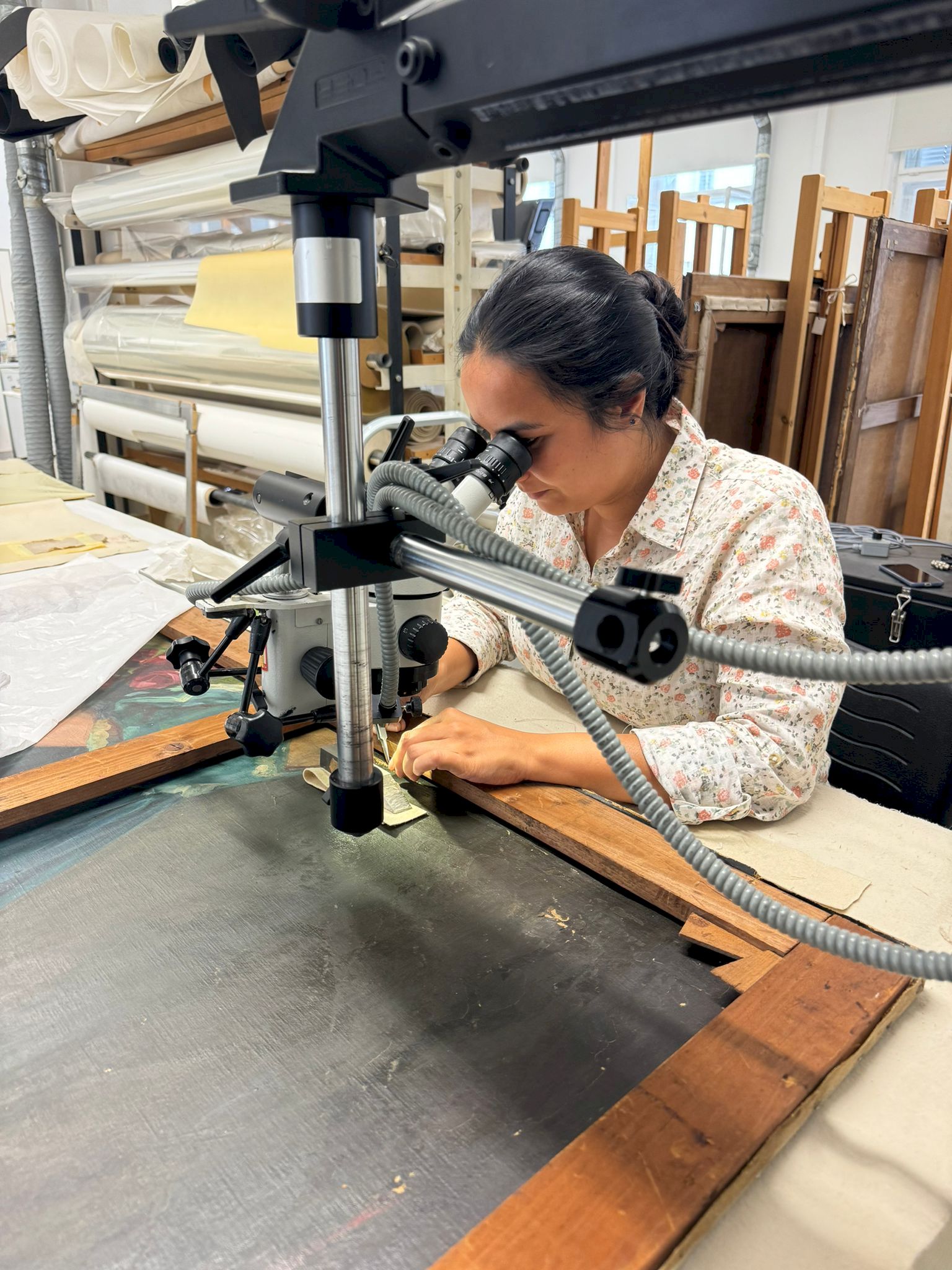
»The CHCM programme reshaped
the way I think about conservation.«
Interview with our graduate Imrana Wasi, runs her own conservation company
CHCM: Why did you choose the Master’s program in »Cultural Heritage Conservation and Management« (CHCM)?
IMRANA WASI: My connection with the University of Applied Arts Vienna began in 2015, when I was selected for the first Indo-Austrian Summer School. The experience stayed with me – I was truly inspired by the teaching approach, the sensitivity towards heritage, and the overall learning environment. When I learned about the CHCM program, it felt like the right step for my growth. The combination of conservation and management, along with the opportunity to study in Austria and Thailand, matched my goal of developing a wider perspective beyond only conservation treatment.
CHCM: What were your expectations of the CHCM and how were they met?
IW: The CHCM programme exceeded my expectations because it helped me grow not just as a conservator, but as a confident and well-rounded professional. I expected to strengthen my conservation knowledge, but I gained much more – improved communication and teaching skills, confidence in presenting my ideas, and the ability to plan and manage conservation projects effectively from start to finish. The curriculum exposed me to new materials, techniques, and approaches in both treatment and preventive conservation, which expanded my perspective beyond what I had previously practiced. Experiencing conservation in Austria and Thailand, and reflecting on it in comparison with India, gave me a deeper understanding of how cultural contexts shape conservation decision-making. Working closely with conservators from different countries and cultures was particularly transformative. It broadened my thinking, enriched the way I collaborate, and encouraged me to bring more empathy, openness, and creativity into my work. Overall, the programme did not just meet my expectations – it elevated them. It empowered me with global exposure, a more holistic approach, and the confidence to contribute meaningfully to the field and to inspire future conservators.
CHCM: What in your opinion is the added value of this program compared to other similar programs?
IW: What sets the CHCM programme apart is its unique combination of conservation and management, which very few courses offer together. The international exposure in Austria and Thailand added immense value, allowing me to learn diverse conservation approaches and reflect on them in the context of India. I also truly benefited from being part of a cohort of trained and experienced conservators from different countries. Learning and working alongside such a skilled and diverse peer group encouraged meaningful knowledge-sharing, strong collaboration, and genuine personal growth. For me, this programme offered a global perspective that I believe every future conservator should experience.
CHCM: How did the CHCM help you in your job search?
IW: The CHCM programme significantly strengthened my profile and gave me the confidence to present myself more effectively during interviews and professional interactions. The international exposure and academic credibility of studying in Austria and Thailand added real value to my CV and helped me stand out in the field. After completing the programme, I began receiving more opportunities … not only in conservation projects but also in teaching and knowledge-sharing. I am now working independently on multiple projects, collaborating with organisations, and have been invited to teach in different institutions and heritage departments. The global perspective, communication skills, and project management training I received through CHCM have played a key role in expanding my professional network and enhancing my career growth.
CHCM: What were the most important lessons you learned from the program?
IW: The CHCM programme reshaped the way I think about conservation. I learned to approach each project with responsibility, ethical awareness, and informed decision-making rather than just focusing on treatment. Working in an international environment taught me how much we grow by listening to different viewpoints and sharing knowledge with one another. The programme strengthened my planning, communication, and teaching skills, and showed me that leadership, teamwork, and sustainability are just as important as technical skills. Most importantly, it taught me to stay open, keep learning, and evolve with the field.
CHCM: What were your most memorable impressions?
IW: The most memorable part of CHCM was learning and sharing knowledge with classmates from different countries, each bringing their own experience and perspective. The programme offered so many lab visits, field visits, museum and gallery trips in both Vienna and Thailand, which gave me hands-on exposure and broadened my understanding of conservation. The guidance and encouragement from mentors helped me trust my own thinking and make decisions confidently. Beyond technical skills, the friendships, cultural exchanges, and the opportunity to think independently made this programme truly transformative – shaping me as both a conservator and a person.
CHCM: What did you study before CHCM and where are you currently employed or working on which project?
IW: I completed my first master’s in Conservation in 2015 from the Indian Institute of Heritage (formerly National Museum Institute), New Delhi, where I focused on the conservation of paintings and cultural objects. Currently, I work as a freelance conservator and run my own conservation company, India Art Conservation Centre. I also serve as visiting faculty at organisations such as IIH and SHRM. CHCM has strengthened my approach, broadened my perspective, and given me the confidence to manage diverse projects and contribute meaningfully to the heritage field.